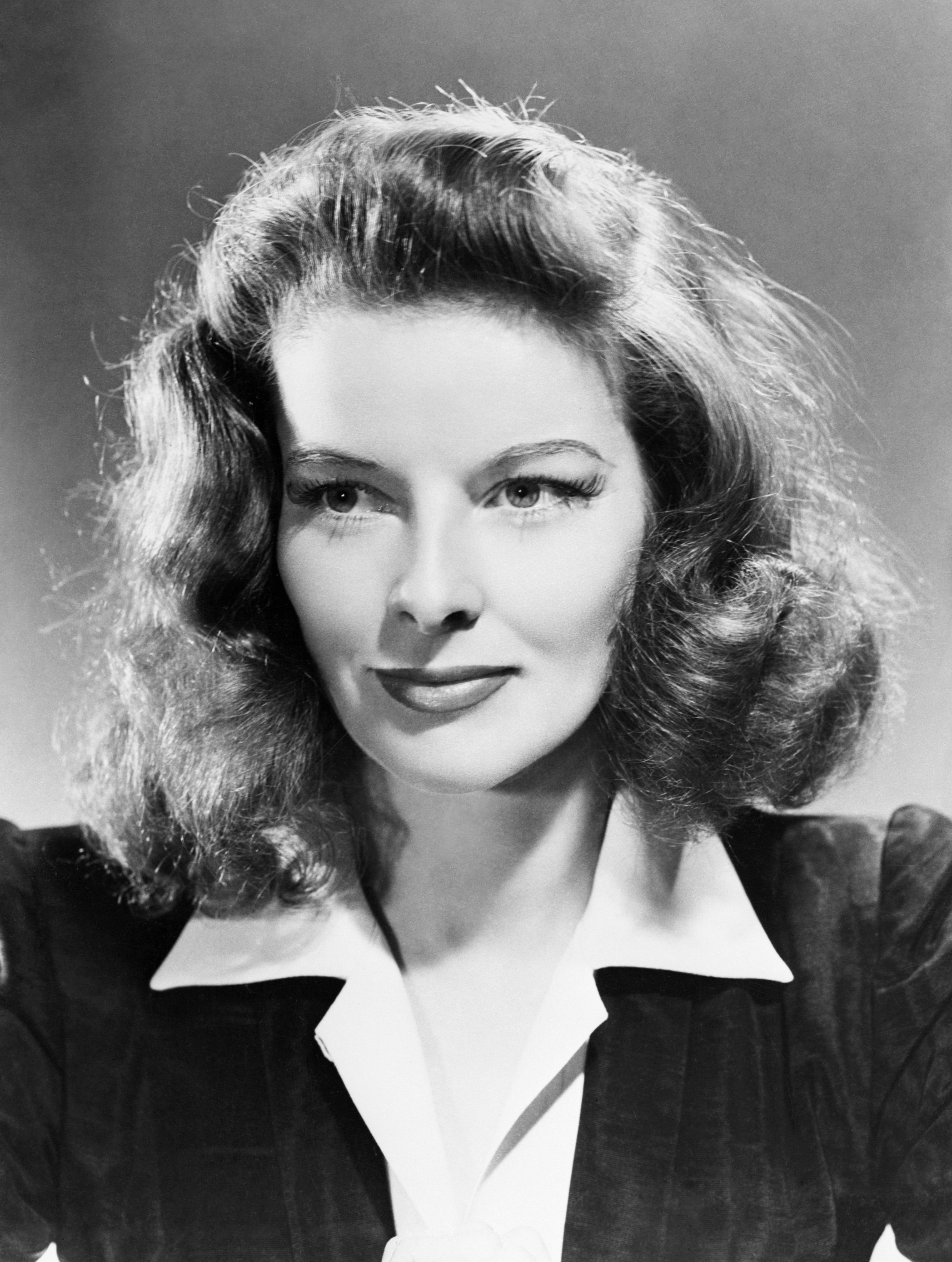
From The Philadelphia Story to the enduring codes of Max Mara, Katharine Hepburn’s approach to dressing helped redefine the relationship between femininity, tailoring and independence.
Long before oversized shirting, wide-legged trousers and masculine tailoring became established elements of the modern woman’s wardrobe, Katharine Hepburn was already dressing according to her own rules.
Her significance to fashion was not built around a single spectacular dress. It came from something considerably more radical: the confidence to make seemingly ordinary clothes extraordinary.

The blouse was part of that language.
Worn with generous trousers, tailored jackets and practical shoes, shirts and blouses became part of Hepburn’s unmistakable silhouette. Against the highly constructed glamour associated with Hollywood, her wardrobe proposed another kind of elegance — intelligent, independent and remarkably modern.
THE BLOUSE AS ATTITUDE
A blouse can be romantic, decorative and delicate. But in Hepburn’s wardrobe, shirting could also borrow the authority traditionally associated with menswear.
Collars framed the face. Sleeves could be relaxed. Trousers sat high at the waist. Rather than restricting the body, the clothes appeared to accommodate movement.
Hepburn was not simply adopting menswear. She demonstrated how its codes could be absorbed into a woman’s wardrobe without diminishing her femininity.
That distinction feels familiar today. In Hepburn’s Hollywood, it was considerably more provocative.
Her preference for trousers and tailored separates challenged expectations surrounding both glamour and feminine presentation. What began as an individual way of dressing gradually became part of a much broader fashion vocabulary.
THE PHILADELPHIA STORY: CHARACTER, CLOTHES AND CONTROL
Released in 1940, The Philadelphia Story presents another fascinating dimension of Hepburn’s relationship with clothes.
As Tracy Lord, Hepburn appears within a world of privilege and immaculate social presentation. Costume designer Adrian created a wardrobe that moves between dramatic evening dressing and refined daywear, demonstrating that Hepburn’s visual authority was never dependent upon masculine clothing alone.
Here, femininity does not equal fragility.
The clothes may change, but the woman occupying them retains control.
That distinction is central to understanding Hepburn as a fashion icon. Her importance was not simply that she wore trousers when women were expected to wear dresses. It was her ability to move between different sartorial languages without allowing the clothes to define the limits of her identity.
The film itself also represents an extraordinary moment of personal agency. After appearing in the stage production, Hepburn obtained the screen rights to the story and used the project as the vehicle for her return to Hollywood.
Fashion and biography intersect beautifully here: both on screen and beyond it, Hepburn was increasingly determining the terms on which she would be seen.
The Philadelphia Story would subsequently become part of fashion’s own cultural memory. Ralph Lauren has identified the film among the classic Hollywood pictures that have informed his creative world — another indication of how Hepburn’s cinematic image continued travelling beyond the screen and into fashion.

FROM HEPBURN TO MAX MARA
The connection between Katharine Hepburn and contemporary fashion becomes particularly compelling when viewed through Max Mara.
Hepburn is not merely a retrospective comparison imposed upon the house.
At Max Mara’s headquarters, creative director Ian Griffiths has included Hepburn among the cinematic “coat icons” on his inspiration board, alongside figures including Greta Garbo, Marlene Dietrich and Marilyn Monroe.
It is an illuminating connection.
The mythology surrounding the Max Mara coat has long extended beyond the garment itself. It represents confidence, movement and a particular kind of understated authority.
Hepburn understood that language instinctively.
Her blouses, trousers and tailoring were compelling not because they made her appear masculine, but because she made garments traditionally associated with masculine authority unquestionably her own.

CLOTHES FOR A WOMAN GOING SOMEWHERE
Founded in 1951 by Achille Maramotti, Max Mara emerged with a vision of ready-to-wear suited to the changing lives of women.
Maramotti anticipated a woman increasingly entering professional life — a woman who required clothes possessing both sophistication and practicality.
That idea remains remarkably contemporary.
Under Ian Griffiths, Max Mara continues to explore the relationship between tailoring, authority and ease. Griffiths has spoken about Maramotti’s vision of an “intelligent and modern” woman and about reconsidering garments associated historically with male authority for a female wardrobe.
The camel coat is perhaps the house’s most recognisable expression of that philosophy.
Its power does not depend upon extravagance. Like Hepburn’s blouse or wide-legged trousers, its impact comes from proportion, construction and the confidence of the person wearing it.
WHEN MENSWEAR BECOMES WOMENSWEAR
This transformation belongs to a much larger story within twentieth-century fashion.
Women did not simply borrow the male wardrobe. Designers, performers and generations of women gradually dismantled the assumption that authority itself had a gender.
A tailored coat could become feminine.
So could trousers.
So could an oversized shirt.
And the blouse could exist somewhere between softness and structure, refusing to choose between the two.
Hepburn embodied that ambiguity decades before contemporary fashion made it familiar.
THE CONTEMPORARY MAX MARA WOMAN
The dialogue remains visible in Max Mara today.
The house continually balances practicality with desire, tailoring with ease and femininity with elements originating in menswear. Griffiths has spoken of something as straightforward as well-tailored trousers worn with a poplin shirt — a combination whose luxury lies as much in cut and confidence as in decoration.
It is tempting to see Hepburn in that image.
Not as a literal reference for every Max Mara collection, nor as evidence that the house is continually designing around her, but as part of the longer cultural lineage to which both belong.
That distinction matters.
Fashion influence is rarely a straight line. It is a conversation across decades: an attitude appears, disappears, is reconsidered and eventually becomes so familiar that we forget it was once radical.
THE LUXURY OF SIMPLICITY
Perhaps Hepburn’s most enduring fashion lesson is that simplicity can possess enormous presence.
A blouse depends upon cut, proportion, fabric and the woman wearing it. A coat depends upon construction and silhouette. A pair of trousers succeeds through the precision of its line.
Remove excessive decoration and character becomes more visible.
This is also why these garments survive fashion’s constant cycle of reinvention.
A beautifully constructed white shirt can belong to 1940 or 2026.
Its proportions may change. Its context changes. The woman wearing it changes.
The essential garment remains.
AN ICON WHO STILL DRESSES THE PRESENT
Katharine Hepburn’s fashion legacy is ultimately about more than trousers, blouses or Hollywood.
It is about autonomy.
From the controlled elegance of Tracy Lord in The Philadelphia Story to the shirts and wide-legged trousers of Hepburn’s personal wardrobe, clothes became different expressions of the same idea: a woman determining how she would present herself.
That idea continues to resonate through contemporary fashion.
Max Mara offers a particularly compelling chapter in that conversation — a house built around sophisticated clothes for women moving through the world, where a coat can carry authority, trousers can communicate elegance and a simple shirt can possess as much presence as an evening gown.
Perhaps that is why Hepburn still belongs on the moodboard.
Fashion changes relentlessly, but certain attitudes endure.
Hers was one of them.
ARRVL — A Contemporary Fashion Diary
By Gulfiya Yebergenova
Founder & Editor-in-Chief, ARRVL
Leave a Reply