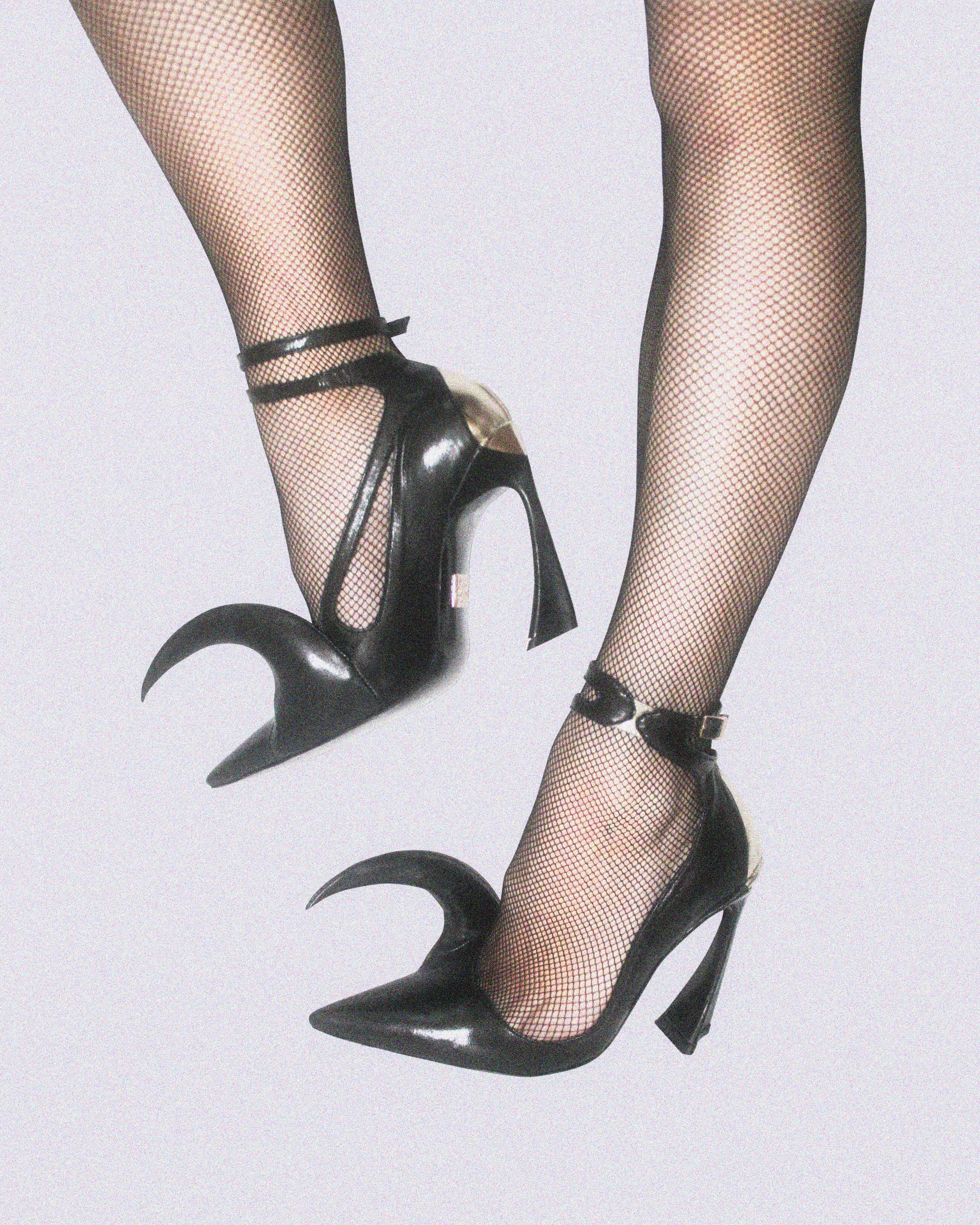
From Australia to London and New York, footwear designer and maker Kira Goodey built a career around craft, experimentation and extraordinary shoes worn by performers. Then she discovered something unexpected: sometimes creative freedom begins when ambition is allowed to change.
Editorial by Gulfiya Yebergenova for ARRVL
There is a version of a fashion career that is easy to tell.
A young creative arrives in a major city. She works relentlessly. Doors begin to open. Her designs find their way onto performers and into images seen around the world. Eventually, persistence becomes success.
Kira Goodey’s story contains all of those ingredients, but she is far less interested in the mythology.
For Goodey, the journey from suburban Australia to London, and eventually New York, has been slower, more complicated and ultimately more revealing. It is a story about craft and ambition, certainly, but also about the economics behind making, the exhaustion that can accompany a dream, and the surprising freedom that arrives when success is no longer the only destination.

London, Before the Shoes
Growing up in suburban Australia, Goodey looked towards London as somewhere almost impossibly distant from the world around her.
“Suburban Australia, when I was growing up, was a cultural desert,” she tells ARRVL. “I wanted to be where the action was, and at that moment in history, London was the centre of the creative universe for me.”
The fantasy of London, however, was followed by its reality.
Arriving without money, qualifications or an established network meant that progress was anything but immediate.
“Starting off in a new city with no money, no qualifications and no connections was challenging,” she says, “and I lost a lot of years just trying to make ends meet.”
It took almost a decade, she remembers, before she felt truly embedded in the city and opportunities began to emerge.
Yet London offered something beyond professional possibility. For a young woman who had grown up fascinated by fashion as a form of self-invention, the city represented permission.
Goodey had been obsessed with Vivienne Westwood and the mythology of the King’s Road in the 1970s — with the idea that clothing could communicate rebellion, identity and belonging.
“That freedom to express yourself through fashion” drew her towards London, she says. In Australia, she had experienced that kind of self-expression very differently. In London, eccentricity could become a vocabulary.

Finding Craft
Shoes were not always the plan.
Around 15 years ago, after a succession of odd jobs and fashion internships that seemed to be leading nowhere, Goodey began asking herself a more fundamental question: what did she actually care about?
The answer was craft.
Weekend shoemaking classes followed, and something clicked.
Many of the skills felt surprisingly transferable, but there was another element that changed everything: sculpture.
“What I really loved that was different was the sculptural element,” she says. “From that point on, I was hooked.”
It is perhaps the sculptural instinct that explains why Goodey’s footwear can resist the conventional boundaries of the shoe. Proportion becomes exaggerated. Materials become protagonists. The foot becomes both practical consideration and starting point for fantasy.
Her process often begins not with a silhouette, but with material.
“I’ve always been very drawn to materials, so often it’s material development or experimentation that gets me excited first.”
But fantasy never entirely replaces the body.
“I’m also conscious that shoes are designed to be worn, so I’m always thinking holistically about how a piece will work on a person and about who that person is.”
Sometimes that person is a client. At other times, it is Goodey herself — or, as she puts it, “an ideal version of me.”

When Fantasy Meets Performance
Eventually, some of those shoes travelled considerably further than the studio.
Goodey’s work entered the visual worlds of performers, including Nicki Minaj, placing her technically demanding footwear inside an environment where fashion is not simply worn but used to construct character.
The experience might appear glamorous from the outside. Goodey describes it with characteristic perspective.
“It’s always amazing to see someone I really respect and admire wearing my work, very flattering,” she says.
Then comes the reality rarely included in the celebrity-fashion narrative:
“Nine times out of ten, I’ll make a pair of shoes and the performer never actually wears them, so on the rare occasions when someone does, it feels extra special.”
It is a small admission that reveals something larger about fashion. Behind a single image exists an invisible chain of making, fittings, styling decisions, discarded options and hours of work that the audience will never see.
And nowhere is that invisible labour more apparent than in the construction of the shoe itself.

The Price of Making
Ask Goodey what working by hand preserves in an industry obsessed with speed, and she initially laughs at the romance of the question.
“That’s a great question! And in all honesty, in my case it’s been more of a disadvantage than anything else.”
It is one of the most revealing observations in our conversation.
Fashion celebrates craftsmanship constantly. The language of the handmade has become synonymous with luxury. Yet the economics of actually making something by hand can tell another story entirely.
“People are used to things being produced extremely fast and extremely cheap, so customers have become detached from the process of making,” Goodey explains.
A relatively straightforward pair of pumps, she says, can involve more than 150 separate processes.
Outside a fully industrialised environment, neither speed nor low prices are realistic.
For an independent maker, the numbers eventually became impossible.
“I’d have needed to charge upwards of £2,000 a pair just to break even on the hours involved, and my customers weren’t prepared to pay that.”
Eventually, Goodey stopped handmaking shoes for clients.
Today, she teaches shoemaking instead.
The transition has shifted the creative equation. Rather than imposing her own vision on an object, she helps another person realise theirs — a process she describes as presenting different challenges, but also its own pleasure.
“That’s the fun of it.”

New York, and Beginning Again
When Goodey moved to New York, she thought shoes were behind her.
Her business had closed. She remained professionally connected to fashion, designing for other brands, but the desire to create footwear under her own name had been exhausted.
“I was burnt out and in a lot of debt from trying to start my own label,” she says.
Then New York did something she hadn’t expected.
“I went to New York thinking I was done with shoes,” she recalls. “New York surprised me with how open people were to offer opportunities, much more than I’d experienced in London.”
Teaching gave her a route back into shoemaking, but on different terms.
Instead of resurrecting the ambition she had left behind, New York allowed her to renegotiate it.
“I don’t care much about shoes in the way I used to anymore, and strangely, that’s made me a better designer and maker.”
There is something quietly radical in that admission.
Fashion tends to celebrate obsession. Creatives are expected to describe their work as an all-consuming calling, ambition as something that should expand indefinitely. Goodey discovered the opposite.
“Letting go of the pressure and the stress, and making room for other interests, gave me a much healthier relationship with fashion.”
There Was No Big Break
Looking backwards, Goodey refuses another familiar fashion narrative: the transformative moment.
There was no phone call that changed everything. No overnight discovery. No clean division between before and after.
“If I’m being candid, it’s all been a slow slog,” she says. “There was never a single moment of change, no ‘big break.’ It’s just been slow and incremental.”
Perhaps that is what makes her story particularly relevant now.
Creative careers are so often compressed into highlights — the celebrity placement, the collaboration, the photograph, the finished object. What disappears from view are the years between those moments: the unpaid work, financial uncertainty, repetition, disappointment and recalibration.
For Goodey, one of the most consequential decisions was not to push harder, but to walk away from an ambition she had once considered fundamental.
She had wanted to build a sustainable brand of her own. Eventually, she concluded that it was not going to happen.
“I still work in the industry and teach shoemaking, but I no longer have any hopes or ambitions for myself within it,” she says.
On paper, the sentence could sound like defeat.
For Goodey, it became liberation.
“It sounds negative, but for me, once the shock wore off, it was amazing. I’m so much happier and unburdened now.”

After Ambition
Today, another creative vocabulary is beginning to occupy the space that fashion once dominated.
Goodey is studying figurative oil painting. She is interested in art and fiction. She writes. Whether any of it eventually becomes public is almost beside the point.
For now, there is no collection to launch, audience to satisfy or commercial expectation attached to it.
Perhaps after years spent constructing objects for other bodies — clients, performers, imagined women — she has arrived at a creative practice that belongs entirely to herself.
“I don’t know whether I’ll ever put my art or writing out into the world,” she says. “Right now it’s just for me, and I’m enjoying that.”
Fashion likes beginnings. It likes arrivals, discoveries and next chapters.
But creative lives are rarely so linear.
Sometimes moving forward means returning to the reason for making in the first place — curiosity without strategy, creation without expectation.
For Kira Goodey, after Australia, London, New York, the shoes, the performers and the years spent pursuing a particular version of success, the destination appears unexpectedly simple.
“I do it to make myself happy, not to please anyone else,” she says.
“And that’s very freeing.”
Kira Goodey in conversation with ARRVL.
Interview and words by Gulfiya Yebergenova.
Leave a Reply