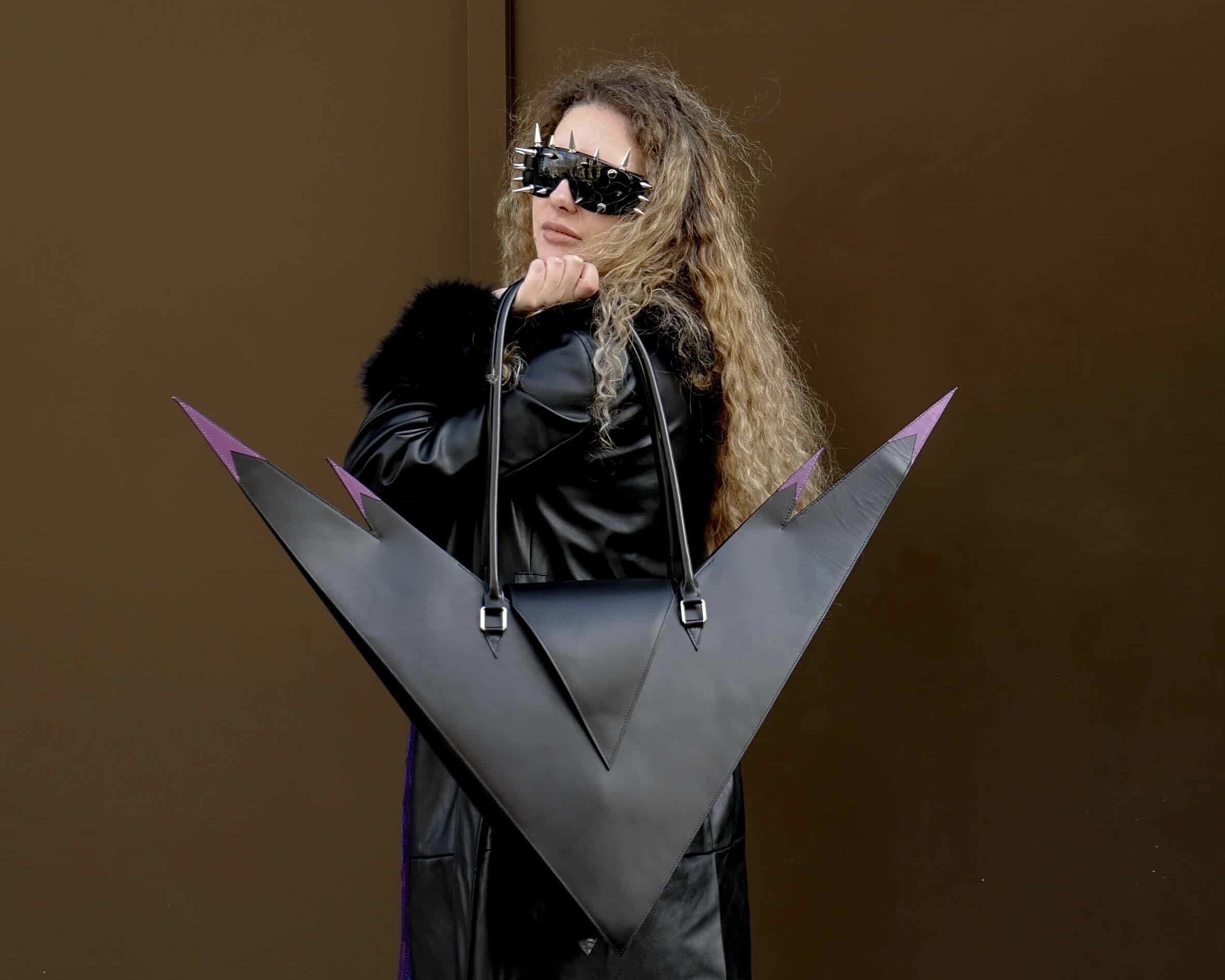
From Transylvania, a new accessories house is turning psychology, gothic atmosphere and architectural form into an unconventional language of luxury.
By Gulfiya Yebergenova | ARRVL
There is something almost defensive about the silhouette of a Nostradovus bag.
The lines are deliberate. Corners sharpen. Leather is held in architectural formations that seem less concerned with decoration than with presence. These are handbags, certainly, but they carry themselves more like objects: part sculpture, part armour, part psychological proposition.
That distinction sits at the centre of Nostradovus, the independent luxury accessories house emerging from Transylvania with an aesthetic that moves between vintage grandeur, gothic romanticism and an almost futuristic severity.
Its proposition is an intriguing one: what if an accessory could express not simply how we want to look, but something of who we have become?
Where Psychology Meets Design
Behind Nostradovus is Mihai Moldovan, whose unusual position as both psychiatrist and designer gives the project its most compelling dimension.
Psychiatry deals with what cannot immediately be seen: vulnerability, identity, resilience, fear, transformation. Fashion makes the invisible visible. For Moldovan, those two worlds converge in an object carried close to the body.
Nostradovus began from this intersection—the idea that strength does not necessarily arrive loudly.
Sometimes it is formed privately, through difficulty, until what was once vulnerability becomes composure.
The handbag becomes a physical expression of that transition.
Rather than treating luxury solely as beauty or status, Nostradovus proposes something more introspective: luxury as contemporary armour.
Not armour designed to conceal the wearer, but something that reflects an authority already present.
A Different Kind of Power Dressing
Fashion has always understood the relationship between clothing and power. The shoulder of a jacket can alter posture. A heel changes the rhythm of a walk. A precisely cut coat can transform the way its wearer enters a room.
Nostradovus brings that psychology to the handbag.
Its sculptural constructions use geometry, proportion and controlled exaggeration to establish presence before ornament. The current collection includes pieces such as DOV NOCTYRA, with its extraordinary wing-like expanse, alongside the sharply structured DOV FEROSIA, DOV DREVAUX and DOV TVALIX.
The forms can be dramatic, but the idea beneath them is quieter.
They are designed for someone who does not necessarily need an accessory to announce status. Instead, the object becomes an extension of character.
There is an interesting contradiction here: the bags demand attention, while the philosophy behind them rejects the need for external validation.
Perhaps that tension is precisely what makes the proposition contemporary.
Transylvania, Reimagined
Then there is Transylvania.
In fashion, geography can easily become cliché. Nostradovus takes a more restrained approach.
The region’s fortified architecture, medieval history and atmosphere of mystery appear not as costume or folklore, but as an emotional backdrop. Darkness is translated into line; history into structure; gothic references into an architectural severity that feels decidedly modern.
The result sits somewhere between past and imagined future.
There are echoes of the glamour and mystery associated with the 1930s, but Nostradovus does not appear interested in nostalgia for its own sake. Vintage codes are interrupted by elongated proportions, sharp geometry and silhouettes that can feel almost otherworldly.
It is a version of gothic luxury stripped of theatrical excess.
The Object as Sculpture
That sense of permanence extends to how the pieces are made.
Nostradovus describes its handbags as handcrafted and made to order, working with European artisans and leather sourced from European tanneries. The approach deliberately moves away from the relentless speed of fashion’s seasonal cycle.
It matters because these objects are conceived to occupy a curious space between accessory and sculpture.
A bag such as DOV NOCTYRA, for example, stretches the familiar vocabulary of a handbag into something considerably more architectural. Its dramatic proportions turn the body carrying it into part of the composition.
Function remains, but it is no longer the entire story.
Placed in a room, the object could almost exist independently of its wearer. Carried through one, it becomes movement, silhouette and attitude.
A Personal Inheritance
Moldovan’s approach also carries a familial thread.
His story brings together science, engineering, artistic sensibility and a connection to textiles and garment-making. Rather than presenting creativity and analytical thinking as opposing forces, Nostradovus allows them to coexist.
That may explain the precision of the bags themselves.
There is emotion in the concept, but discipline in the execution. Romantic references are contained within strict geometry. Mystery is controlled by proportion.
It is this friction—between vulnerability and strength, history and futurism, psychology and object—that gives Nostradovus its identity.
Beyond the Handbag
For a young independent house, establishing a recognisable visual language is perhaps more valuable than attempting to speak to everyone.
Nostradovus already appears determined about its vocabulary.
It is dark without being purely gothic, sculptural without abandoning function, and luxurious without relying entirely upon traditional symbols of luxury. Its official positioning describes pieces that blur the boundary between style and armour—a philosophy visible throughout the collection.
But the most interesting idea may exist beyond the bags themselves.
Fashion is often discussed as transformation: the possibility of becoming somebody different through what we wear. Nostradovus suggests almost the reverse.
Perhaps the most powerful object is not the one that transforms us.
Perhaps it is the one that reveals what was already there.
And when an accessory can translate that inner certainty into physical form, a handbag stops being merely something we carry.
It becomes a way of occupying space.
ARRVL encountered the Nostradovus team through street style, where the house’s sculptural bags moved beyond the controlled language of a campaign—carried, styled and seen in motion.


The Nostradovus team captured in street style.
Photography by Gulfiya Yebergenova for ARRVL.
Leave a Reply