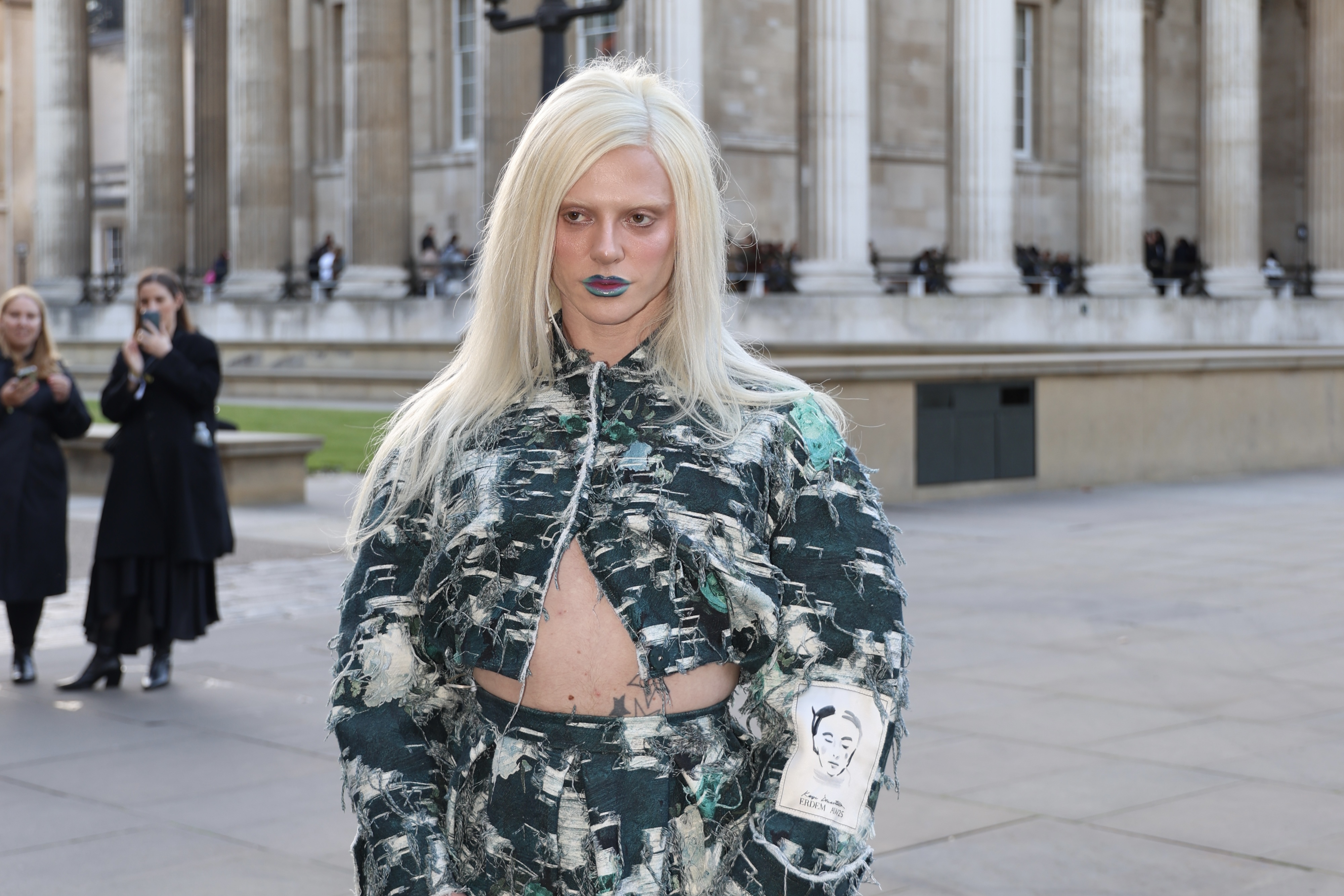
Two seasons at the British Museum, two very different women at the centre of Erdem Moralıoğlu’s imagination — and a photographer discovering the compelling theatre that exists beyond the runway.
Editorial and Photography by Gulfiya Yebergenova for ARRVL
Before a fashion show begins, there is another show taking place outside.
It is shorter, less controlled and entirely unpredictable. Cars pull towards the pavement. Photographers tighten their positions. Editors, actors, stylists, buyers and familiar faces move through the crowd. An extraordinary coat is visible for perhaps ten seconds; a dress catches the wind; somebody turns towards the cameras and then disappears behind the doors.
At ERDEM, those doors belonged to the British Museum.

It was here that my own relationship with fashion photography began: not from a runway seat, but outside, camera in hand, watching London Fashion Week assemble itself in real time.

I had arrived perhaps 30 or 40 minutes early, curious to see what happened around a fashion show. Gradually, photographers appeared from across the international fashion circuit. Then came the guests.

I photographed instinctively.
There was something intoxicating about the speed of it all. The clothes were no longer static images on a screen. They moved through London, worn by the people who inhabited fashion’s wider world. Each arrival offered only a few seconds in which to see, compose and capture.

Then the show began.
The photographers disappeared. The gates quietened. Somewhere inside the museum, another world was unfolding.
I stayed outside.

A Portrait in Memory
For Autumn/Winter 2025, presented at the British Museum in February, Erdem Moralıoğlu turned towards something unusually intimate: his late mother, Marlene.
At the centre of the collection was a collaboration with British painter Kaye Donachie, a contemporary of Moralıoğlu’s during their years at the Royal College of Art. The designer had commissioned Donachie to paint Marlene’s portrait; from that exchange emerged a collection preoccupied with portraiture, remembrance and the imperfect ways in which we reconstruct a person after they are gone.

The portrait itself entered the clothes.
Marlene’s image appeared across the opening dress, collapsing the distance between painting and garment, private memory and public collection. Elsewhere, the dialogue became less literal. What mattered was not straightforward biography but atmosphere — the haziness of remembering, the fragments through which another person remains present.
It was a particularly ERDEM proposition.

Moralıoğlu has long been fascinated by women whose lives can be rediscovered through archives, paintings, letters and cultural fragments. He does not simply reproduce their wardrobes. He builds characters around them, allowing history to become a starting point rather than a destination.
At the British Museum, that sensibility found an almost inevitable setting.
Surrounded by objects preserved because somebody decided they mattered, a collection concerned with memory asked a quieter question: what, exactly, do we preserve of a person?
From Memory to Fantasy
By September, ERDEM was back at the British Museum.
The architecture remained. The woman had changed.
For Spring/Summer 2026, Moralıoğlu entered the extraordinary imaginative universe of Hélène Smith, the 19th-century Swiss medium whose visions transported her through multiple identities and worlds.

Smith claimed experiences of other existences — from the court of Marie Antoinette to India and, most fantastically, Mars. Her visions provided Moralıoğlu with a wardrobe liberated from the logic of a single period.
Rococo gestures could meet saturated colour. Historical references could dissolve into fantasy. Femininity became multiple rather than fixed: romantic, eccentric, theatrical and otherworldly.

Placed beside Autumn/Winter 2025, the shift is fascinating.
One season began with a real woman reconstructed through memory.
The next began with a woman who reconstructed herself through imagination.
Memory and fantasy. Portrait and apparition.
Different stories, yet both reveal something essential about the ERDEM woman: she rarely arrives without a past.

The ERDEM Woman
There is romance in Moralıoğlu’s work, certainly, but romance alone is too simple a description.
His collections often carry a sense of excavation.
A woman is found somewhere — inside a painting, an archive, a novel, a forgotten biography — and gradually brought into the present. The historical reference may remain visible, but it is unsettled by contemporary proportion, fabric, styling and attitude.
That tension is what prevents the clothes from becoming costume.
The women who inspire ERDEM may belong to another century; the woman wearing ERDEM belongs emphatically to this one.
And outside the British Museum, another interpretation of that woman was taking place.
The Other Runway
Guest arrivals have their own choreography.
Unlike the runway, nobody controls the sequence. There is no casting order, no lighting cue and no guarantee that the person approaching will look towards your camera.
That unpredictability is precisely what makes photographing it compelling.

Through my lens, I became interested not only in who was arriving but in the moments surrounding the arrival: movement, expression, an unexpected interaction, the way a silhouette changes as somebody walks rather than poses.
These photographs form a parallel record of fashion week.
Inside, a designer presents a meticulously constructed proposition for a season.
Outside, fashion is already being interpreted by the people who live within its culture.
The two worlds last only metres apart.

For a long time, I knew only the second one.
I remember watching the photographers disappear when the show started and wondering what was happening inside. I wanted to see the runway, the atmosphere, the collection in movement. But there was also something exhilarating about remaining at the gates.
When the show finished, the museum released its guests back into London and the cameras began again.
I kept shooting.
Eventually, my SD card was full.
Two Seasons, One Beginning

Returning to ERDEM at the British Museum months later changed the experience.
The rhythms that had once seemed mysterious were becoming familiar: the gathering photographers, the arriving cars, the sudden intensity before the doors close, the quiet during the show and the second burst of movement afterwards.

Yet the excitement remained.
Photography has a peculiar relationship with fashion because both are obsessed with the moment — and with what remains after it has passed.

A collection appears, is photographed, discussed and replaced by another season. Guests arrive and disappear within seconds. A look exists in front of the lens for the fraction of time required to release the shutter.

Then it becomes an image.
Looking back at my ERDEM photographs now, I see more than guest arrivals.

I see the beginning of my understanding of fashion as a world I wanted to document.
That first experience outside the British Museum gave me no certainty about where photography would take me. There was simply curiosity, a camera and the extraordinary sensation that I had found somewhere I wanted to remain.

Since then, fashion has taken me far beyond those gates.
But every photographer has a first frame, a first show, a first moment when observing becomes belonging.

For me, that moment began with ERDEM.
Leave a Reply