Across two Paris seasons, ARRVL turns its lens towards the personalities surrounding Schiaparelli — and the particular visual culture that has always existed wherever the house goes.
Editorial & Photography by Gulfiya Yebergenova for ARRVL

Schiaparelli has never made much sense in half measures.
From Elsa Schiaparelli’s earliest provocations to Daniel Roseberry’s contemporary couture, the house has preferred the improbable to the polite: anatomy rendered in gold, familiar objects displaced from their purpose, bodies exaggerated and silhouettes pushed towards fantasy. The effect can be beautiful, unsettling, humorous — sometimes all three at once.

It also makes for a particular kind of audience.
Across two Schiaparelli shows in Paris in 2026 — Haute Couture in January and ready-to-wear in March — I photographed the personalities drawn into this world. Cinema, publishing, styling, photography and digital culture converged around the house, each bringing a different interpretation of what it means to dress for Schiaparelli.

The interesting frame is rarely the expected one.
It arrives somewhere between performance and instinct — a glance held for half a second, a silhouette briefly separated from the crowd, an extraordinary garment caught behaving ordinarily.
That is where these photographs begin.

THE SCHIAPARELLI INSTINCT
Elsa Schiaparelli understood the value of interruption.
Fashion, in her hands, could make the familiar strange. Her dialogue with Surrealism — and collaborations with artists including Salvador Dalí and Jean Cocteau — produced some of the twentieth century’s most enduring fashion images: a lobster travelling across an evening dress, a shoe becoming a hat, the structure of the human skeleton emerging from the surface of a gown.

They were clothes, certainly.
But they were also ideas.
That distinction remains important to understanding Schiaparelli today.
Since taking the creative direction of the house in 2019, Daniel Roseberry has developed his own vocabulary of spectacle: sculptural bodies, anatomical jewellery, gilded surfaces, exaggerated proportion and couture workmanship pushed towards the fantastical.

The references may belong to different eras. The impulse feels remarkably familiar.
Make the eye stop.
JANUARY: COUTURE
For Spring/Summer 2026 Haute Couture, Roseberry called his collection The Agony and the Ecstasy.
Its emotional starting point came from an encounter with Michelangelo’s Sistine Chapel — and the tension between intellectual control and the overwhelming experience of simply looking.
It is an idea that feels particularly appropriate to Schiaparelli.
The house has always occupied that territory between craftsmanship and sensation: extraordinary technique deployed in pursuit of something almost irrational.
Around the January show, that intensity extended beyond the collection itself.

Demi Moore arrived with an ease that required little embellishment. Teyana Taylor and Jodie Turner-Smith brought a more assertive physicality to the scene; Law Roach, whose career has been built around understanding precisely how clothes and personality can create an image together, offered another perspective altogether.
But a guest-arrival photograph is not really about recording a famous person entering a building.

It is about what happens to fashion once control is removed.
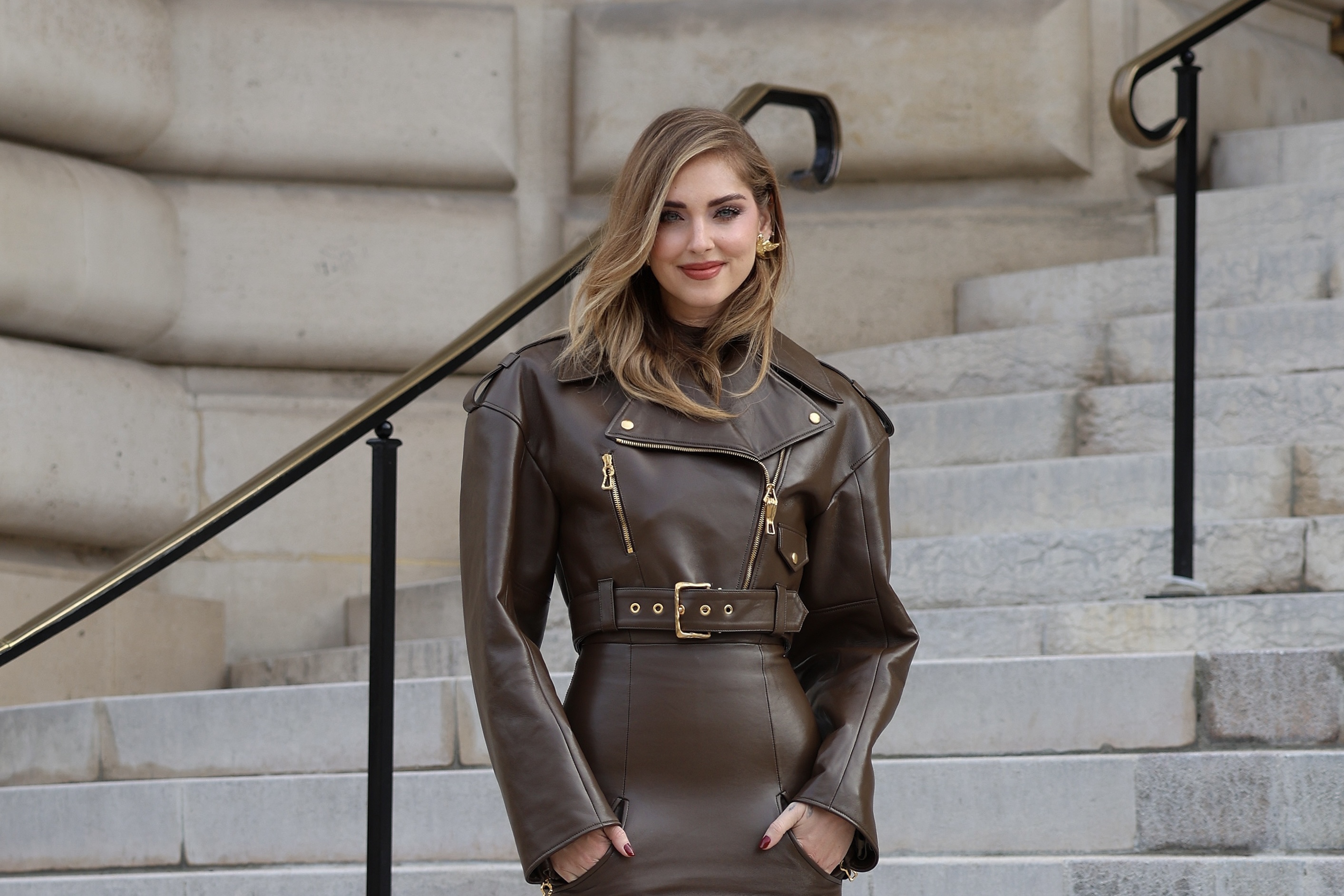
A hem catches movement. Jewellery finds daylight rather than runway lighting. A face turns away at precisely the moment you expected it to turn towards you. Paris inserts itself into the composition.

The photograph has to accommodate all of it.
Sometimes, the imperfection is the picture.
MARCH: THE ORBIT EXPANDS
By March, Schiaparelli was asking another question.
For Fall/Winter 2026–27, The Sphynx considered the contradictions surrounding fashion itself: commerce and imagination, desire and practicality, the necessity of selling clothes and the equally necessary fantasy that makes people want them in the first place.

Outside, those contradictions seemed almost visible.
Edward Enninful — a figure whose career has helped determine how generations encounter fashion through images — was among those arriving. So was Nadia Lee Cohen, whose meticulously constructed photographic universe has its own affinity with the surreal and uncanny.

Farida Khelfa and Marisa Berenson carried another kind of fashion memory: the ease of people for whom the industry is not an occasional destination but part of a life lived within it.

Alongside them, Chiara Ferragni, Heart Evangelista and Leonie Hanne represented a different mechanism of contemporary visibility — one in which an arrival in Paris can become a global image almost before the guest has taken their seat.
Different generations. Different forms of influence.
One doorway.
That collision is precisely what makes the arrivals interesting.

WHEN FASHION LEAVES THE RUNWAY
On a runway, a look exists within a complete visual argument.
Lighting, casting, music, pace and architecture have been considered. The designer controls almost everything.
The street removes that certainty.
Here, clothes encounter weather, traffic, spectators, phones, photographers and the practical business of moving from one place to another.
A couture-adjacent silhouette suddenly has to cross a pavement.
Something monumental becomes human.
For me, this is where guest-arrival photography becomes more than documentation.
The camera records not only what someone wore, but how they inhabited it.
There is a difference.
ANOTHER SCHIAPARELLI, IN LONDON
I encountered Schiaparelli differently in London.
At the Victoria and Albert Museum, Schiaparelli: Fashion Becomes Art places Elsa’s radical imagination alongside the contemporary language of the house, tracing a creative history in which fashion repeatedly escapes the boundaries assigned to it.

After Paris, the stillness felt almost luxurious.
Objects I was accustomed to understanding through movement and imagery could be considered slowly. Construction became visible. Humour revealed itself in details. The strangeness of an idea became clearer when separated from the speed with which contemporary fashion is usually consumed.
For a photographer, the contrast was striking.
Paris had offered fractions of seconds.
The museum offered time.

And somewhere between the two, Schiaparelli made more sense.
The house’s fascination with spectacle is not simply about creating something extravagant enough to be photographed. Its history suggests something more interesting: an understanding that an image can alter the way an object is remembered.
Elsa knew it.
Roseberry knows it.
And today’s audience participates in it.
IN ITS ORBIT
Look closely at the people surrounding a fashion house and another portrait begins to emerge.
Not of a collection, but of its cultural reach.
Actors, editors, stylists, photographers, models and digital personalities arrive carrying their own histories and their own relationship with clothes. For a brief moment, those identities intersect with the identity of the house.
Schiaparelli makes that intersection unusually visible.
Perhaps because neutrality has never been part of its vocabulary.
Across January and March, my photographs became a record of that orbit — not simply who attended, but how the Schiaparelli universe moves beyond the runway and into the city around it.
A look becomes a gesture.
A guest becomes an image.
Paris becomes the backdrop.
And then, almost immediately, the moment is over.
The runway tells us what Schiaparelli has made.
The people surrounding it tell us something about the world that still wants to look.
