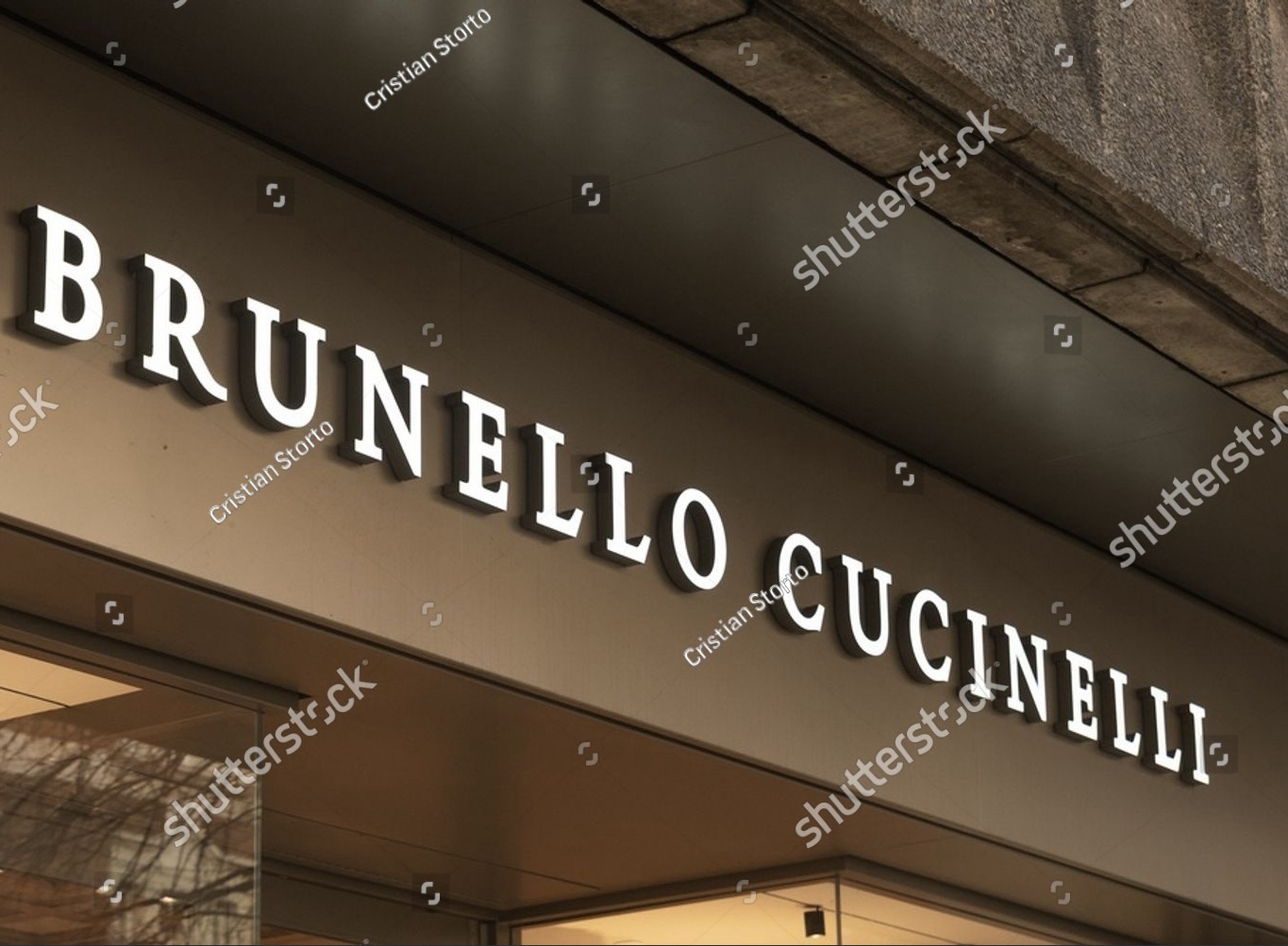
In Solomeo, luxury is measured not only in cashmere and craftsmanship, but in time, place and the belief that what we make should outlive the moment in which it was made.
Editorial by Gulfiya Yebergenova, Editor-in-Chief, ARRVL

There is a particular kind of luxury that announces itself before it enters a room. And then there is Brunello Cucinelli.
Its language is quieter: the weight of cashmere, the fall of an impeccably cut trouser, the complexity of a seemingly effortless neutral palette. Nothing appears to be trying too hard. That ease, however, is deceptive. Behind it sits one of contemporary fashion’s most carefully constructed ideas about what luxury should mean.
To understand Brunello Cucinelli, it is tempting to begin with cashmere.
Perhaps it is more revealing to begin with dignity.
Born in 1953 into a farming family near Perugia, Cucinelli spent his early childhood in the Umbrian countryside. He has often recalled the effect of watching his father return from factory work having experienced humiliation there. The memory would eventually become central to an idea that followed him into business: work could be economically productive without diminishing the person doing it.
In 1978, after leaving engineering studies, Cucinelli established a small company with an idea that was straightforward but quietly disruptive. Cashmere, traditionally associated with restrained and conservative colours, could be dyed in vivid shades.
It was the beginning of a business.
The philosophy would find its physical expression in Solomeo.
A Village as an Idea
Cucinelli moved to the medieval Umbrian hamlet in the early 1980s after marrying Federica Benda, who was born there. In 1985, he purchased its deteriorated 14th-century castle and began restoring it as the company’s headquarters.
The decision feels almost unimaginable through the lens of contemporary fashion, an industry whose geography is normally determined by proximity to capitals, showrooms, airports and financial centres.
Cucinelli went in the opposite direction.
Instead of taking the company away from the village, he gradually built the identity of the company around it.
Solomeo became headquarters, workshop, cultural project and, eventually, something close to a physical manifesto.
Over the decades came the restoration of historic buildings and the creation of cultural spaces: a theatre, library, amphitheatre, Garden of Philosophers and Forum of the Arts. Later, the landscape below the village became part of the project too, with former industrial areas rehabilitated and land returned to agriculture, gardens and public life.
Luxury houses have always constructed worlds around themselves. They build flagships, foundations, exhibitions and spectacular temporary spaces. Cucinelli’s world-building works differently. Its centre is not an invented universe but a real village, one that existed centuries before the clothes.
The brand has therefore attached itself not merely to an aesthetic, but to a sense of continuity.

The Human Hand
Fashion speaks constantly about craftsmanship. At Cucinelli, the idea has been institutionalised.
In 2013, the School of Contemporary High Craftsmanship and Arts was established in Solomeo, drawing inspiration from thinkers including John Ruskin and William Morris. Its purpose reaches beyond nostalgia for a pre-industrial world. It is concerned with the preservation and transmission of skills that risk disappearing when manual work loses social and economic value.
The hand-made object occupies an unusual position in modern luxury. Its hours of labour, knowledge and scarcity become increasingly valuable precisely as the rest of the world accelerates.
Technology makes things faster.
Luxury, at its most convincing, often asks us to value what cannot be hurried.
This tension lies at the centre of Cucinelli’s appeal.
The clothes themselves rarely depend upon shock. Their power is found in proportion, material, touch and construction: cashmere, tailoring, knitwear and softly controlled layers whose apparent simplicity can conceal considerable technical work.
The result is clothing that does not demand immediate interpretation.
It asks to be lived in.

Beyond Quiet Luxury
It would be easy to place Brunello Cucinelli inside the phenomenon fashion has recently called quiet luxury.
It would also be reductive.
Neutral colour, discreet branding and exceptional materials existed long before the term became a cultural shorthand. Cucinelli’s aesthetic was established decades before fashion rediscovered the desirability of understatement.
More importantly, the recent collections suggest a house unwilling to be imprisoned by its own restraint.
For Autumn/Winter 2026, artisanal experimentation became more expressive: richly worked knitwear, texture, lace-like constructions, fringe and embellishment appeared alongside the relaxed tailoring and sophisticated layering associated with the house.
Cucinelli described the mood as “country couture.”
The phrase is revealing.
This is not minimalism for minimalism’s sake. It is an attempt to make richness feel effortless — to allow technique to become visible without permitting it to overwhelm the person wearing it.
That distinction may explain why the house has remained recognisable while continuing to evolve.
The Business of Restraint
There is another reason Brunello Cucinelli feels particularly relevant now.
In an industry often driven by acceleration — more collections, more visibility, more immediacy — the house has built its identity around a different rhythm. When the company listed on the Milan Stock Exchange in 2012, Cucinelli spoke of growth not simply as expansion, but as something that should remain measured, sustainable and capable of lasting across generations.
More than a decade later, that philosophy feels increasingly contemporary.
Cucinelli’s proposition rests on material excellence, craftsmanship and an unusually coherent sense of place. A cashmere jacket exists within a much larger world: the artisans who make it, the Umbrian landscape surrounding the company, the architecture of Solomeo and an idea of Italian culture that refuses to separate beauty from everyday life.
Perhaps this is where the house offers one of its most interesting arguments about modern luxury.
Value does not always have to announce itself. Sometimes its greatest expression is the time, knowledge and human touch contained within something made to last.
From One Generation to the Next
The future of a founder-led house inevitably brings another question: what survives when the founder is no longer the only author of its identity?
Cucinelli has been preparing for that question for years.
His daughters, Camilla and Carolina, are involved in the company, while a wider family and management structure has increasingly taken responsibility for its future. Yet Brunello Cucinelli remains Executive Chairman and Creative Director.
The challenge is significant.
Fashion history is filled with houses that survived their founders by reinventing themselves, and others that preserved a name while gradually losing the particular intelligence that once gave the name meaning.
Cucinelli’s greatest inheritance may therefore not be a silhouette or a colour palette.
It may be a system of values sufficiently clear to be interpreted by another generation.
Humanity in a Technological Age
There is an unexpected dimension to this story: artificial intelligence.
For a man whose public vocabulary revolves around philosophers, artisans, ancient villages and the dignity of the human hand, Cucinelli has not positioned technology simply as an adversary. His thinking around what he calls Human Artificial Intelligence instead asks how technological progress might remain guided by human values.
The apparent contradiction is perhaps one of the most contemporary elements of the Cucinelli story.
Preserving craftsmanship does not require pretending that technology does not exist. Preserving humanity may instead require deciding where technology belongs — and where the human hand, judgement and imagination remain irreplaceable.
It is a question that reaches far beyond one fashion house.
As artificial intelligence enters increasingly creative territory, luxury will have to decide what it is ultimately protecting. Efficiency can be replicated. Speed can always increase. But knowledge passed from one pair of hands to another, judgement formed over decades and the subtle irregularities of human making belong to a different measure of value.
Perhaps this is ultimately why Brunello Cucinelli matters beyond cashmere.
The house proposes that modernity does not always require rupture with what came before.
A medieval village can become the headquarters of a global fashion house. An artisan’s hand can coexist with artificial intelligence. A contemporary company can speak about philosophy. A garment can command attention without demanding it.
And in an industry accustomed to defining the future through constant reinvention, one of luxury’s more radical possibilities may be something much older:
to make fewer gestures, make them carefully, and give them enough meaning to last.
ARRVL — A Contemporary Fashion Diary
