At Paris Fashion Week, Alexandre Belzacq presented CONCORDE’s 2027 collection, When Will You Return?, exploring the delicate emotions of departure, separation and reunion through sculptural silhouettes, innovative construction and contemporary French craftsmanship.
Editorial by Gulfiya Yebergenova
Beyond the Destination
There is something profoundly human about the act of departure. The anticipation of a journey, the uncertainty of separation, the quiet hope of reunion. These fleeting moments, often overlooked in the rhythm of everyday life, became the emotional foundation of CONCORDE Paris’s 2027 collection, When Will You Return?


Presented on 3 October 2026 at 63 Quai de la Tournelle in Paris, the collection marked the second chapter in the creative evolution of Alexandre Belzacq’s Parisian fashion house. Rather than approaching travel through the familiar language of escapism and destination dressing, Belzacq turned his attention towards the emotional experiences that unfold between places.
Airports, railway stations and departure terminals became imagined settings for stories of connection, longing and uncertainty. Within these transitional spaces, strangers briefly encounter one another, relationships are tested by distance, and ordinary gestures acquire extraordinary significance.
It is an evocative starting point for a collection that seeks to move beyond the purely aesthetic, positioning clothing as an expression of the experiences we carry with us.
When Presentation Becomes Part of the Story
At the Paris presentation, the designer’s attention to storytelling was evident before the collection itself came into view.
Placed on the seats were striking deep-blue paper constructions, meticulously folded into the shape of tailored shirts. Complete with structured collars and CONCORDE labels positioned inside the neckline, these unexpected objects contained the collection’s press materials.
It was a beautifully considered detail.


Rather than presenting guests with a conventional programme, the house transformed a familiar wardrobe essential into a sculptural object, establishing an immediate connection between the audience and the creative world they were about to discover.
The gesture spoke to the collection’s wider fascination with construction, transformation and the relationship between objects and their meaning.
In an industry increasingly preoccupied with spectacle, such thoughtful details offer a different form of sophistication. They suggest that a designer’s identity can be communicated not only through the garments themselves, but through every element surrounding their presentation.
For CONCORDE, the narrative had already begun before the clothes appeared.
The Architecture of Human Connection
Central to When Will You Return? is the idea that clothing can communicate emotions that words sometimes struggle to express.

Belzacq explores this concept through an architectural approach to silhouette, where exaggerated volumes, structural interventions and unexpected proportions create a visual language of tension and movement.
The knot emerges as one of the collection’s defining motifs.
Traditionally associated with fastening, security and connection, it takes on a more intimate significance here, symbolising the invisible bonds that remain between individuals despite physical separation.
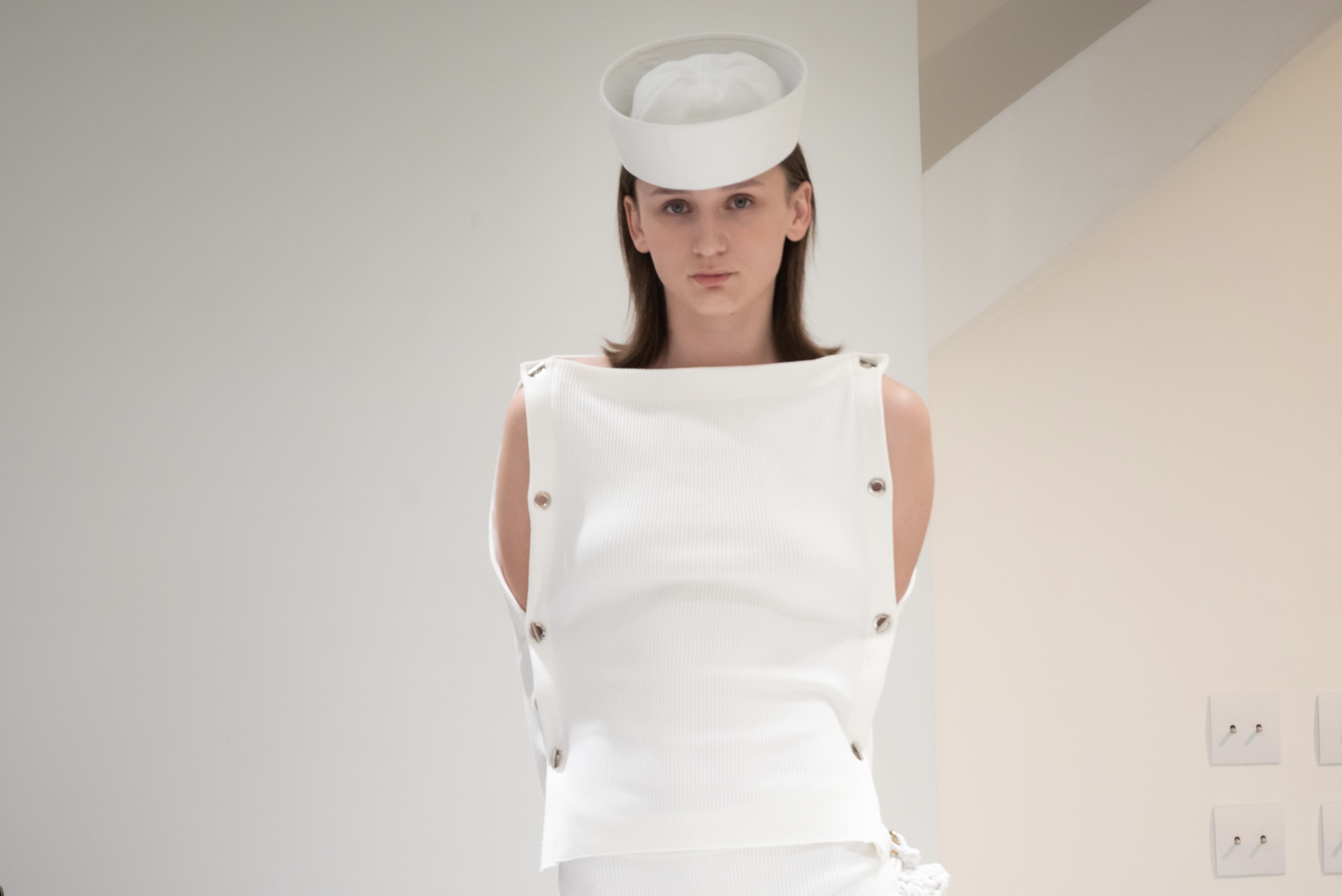
Rope detailing extends this symbolism throughout the collection, referencing the maritime world while suggesting continuity, attachment and the possibility of reunion.
The concept becomes particularly compelling in the collection’s modular construction.
Garments can be tied, untied, separated and reassembled, allowing their forms to evolve with the wearer. These transformations echo the changing nature of human relationships, where connections are continually negotiated, altered and renewed.
There is a deliberate tension between permanence and impermanence, between the desire to hold on and the necessity of letting go.
Through this interplay, Belzacq proposes a wardrobe that is not entirely fixed, but responsive to movement and transformation.
A Parisian Perspective on Contemporary Dressing

Although CONCORDE’s inspiration is deeply personal, its design vocabulary reflects a broader conversation taking place within contemporary French fashion.
The collection moves between architectural experimentation and the familiarity of everyday dressing, reconsidering traditional wardrobe pieces through unconventional construction.
Shirts, trousers and jackets are reimagined with sculptural proportions, while fluid silhouettes introduce a sense of movement that contrasts with the more structured elements.
A restrained palette of deep blues, greys, blacks and whites reinforces the collection’s introspective character.
Rather than relying on colour to create impact, Belzacq directs attention towards shape, material and the relationship between garments and the body.
Travel remains a recurring influence, extending beyond the collection’s narrative into its accessories and volumes.
Sculptural forms evoke the hulls of boats and the masts of ships, while bags reinterpret the shapes of aircraft wings, sails and railway carriages.
These references reveal the designer’s interest in translating functional structures into fashion.
For Belzacq, who was originally trained as an engineer and grew up surrounded by the world of aviation, this relationship between technical precision and creative expression is particularly significant.
His early ambition to become a pilot eventually developed into a fascination with fashion as another means of exploring movement, imagination and human experience.
The resulting aesthetic is one in which construction becomes inseparable from storytelling.
Craftsmanship, Collaboration and Material Exploration
Beyond its conceptual ambitions, the collection places considerable emphasis on craftsmanship and the possibilities of material experimentation.
Denim and crochet appear alongside luxury deadstock fabrics, introducing contrasts between familiar textures and more unconventional forms.

Handmade crochet elements, created by Martha Torbey, bring an artisanal sensibility to the collection, softening its architectural vocabulary while reinforcing its interest in connection and construction.
The intricate nature of crochet, in which individual threads are interwoven to create a unified structure, feels especially appropriate within a collection concerned with the relationships that bind people together.
Another notable element is CONCORDE’s collaboration with French brand Tricots Marcel.
Known for its signature undershirts and tank tops, the brand brings an established vocabulary of French everyday dressing into dialogue with Belzacq’s more experimental approach.
Selected pieces have been reworked with rope-embroidered detailing, connecting the collaboration to the collection’s recurring maritime references.
The partnership offers an interesting contrast between heritage and contemporary experimentation, demonstrating how familiar garments can acquire new relevance through creative reinterpretation.
The use of existing and deadstock materials also reflects CONCORDE’s stated interest in more considered production practices.
For a fashion house whose identity is closely connected to travel, the relationship between movement and environmental responsibility presents an ongoing challenge. The incorporation of existing materials suggests one way in which the label is beginning to address that tension.
Fashion as a Form of Storytelling
Perhaps the collection’s most distinctive quality is its cinematic imagination.

Belzacq approaches his designs almost as characters within a larger narrative, imagining the lives and emotions of people encountered in places of transit.
A couple separating before a flight. A mother waiting at a terminal. A friend disappearing into a crowd. A traveller hesitating between departure and return.
These imagined encounters are deliberately incomplete.
Like observing strangers across a railway platform, the audience is invited to consider the stories that might exist beyond a single moment.
Each silhouette becomes an extension of a character, with volume, construction and movement suggesting different emotional states.
It is a perspective that reflects Belzacq’s wider creative interests in cinema, sculpture, drawing and performance.
Speaking about the inspiration behind the collection, the designer explains:
“At first, I was simply living my own stories in these places. Then I began observing the people around me, watching them wait, run, meet again or say goodbye.”
He continues:
“With When will you return?, I wanted to tell those moments when, for a few seconds, our lives seem to intersect and emotions suddenly become visible.”
The observation reveals something essential about his approach.
Rather than attempting to illustrate a single narrative, Belzacq creates space for multiple interpretations. His garments become part of an imagined world in which every individual carries a different history, and every departure suggests the possibility of another beginning.
The Beauty of Being in Between
As emerging designers navigate an increasingly competitive fashion landscape, establishing a distinctive creative identity has become as important as developing a recognisable aesthetic.
For CONCORDE Paris, that identity appears to be taking shape through a compelling combination of personal history, architectural experimentation and emotional storytelling.
Belzacq’s fascination with aviation, movement and human connection provides a coherent foundation for a label that approaches fashion as something more than seasonal reinvention.
What makes When Will You Return? particularly interesting is its ability to connect abstract emotions with tangible design elements. Knots become symbols of attachment, modular garments reflect transformation, and sculptural volumes evoke the structures that carry us between destinations.
The presentation itself reinforced this vision. From the carefully constructed paper-shirt press materials to the collection’s exploration of craftsmanship and form, the attention to narrative extended beyond the garments.
There is an appealing sincerity in this approach. Rather than pursuing novelty for its own sake, CONCORDE appears interested in developing a visual language rooted in the designer’s personal experiences and observations.
For ARRVL Magazine, discovering emerging creative voices remains an essential part of understanding how contemporary fashion continues to evolve. CONCORDE’s Paris presentation offered an opportunity to encounter a designer whose work brings together imagination, technical curiosity and a thoughtful exploration of the human experience.
With his 2027 collection, Alexandre Belzacq reminds us that fashion can capture something of the emotional complexity of everyday life.
Because between departure and arrival, between what we leave behind and what lies ahead, there exists a space filled with uncertainty, anticipation and possibility.
And perhaps it is precisely there, in those fleeting moments of transition, that we discover the beauty of being in between.
