For Spring/Summer 2027, Erdem Moralioglu enters the suspended world of Barbette, where tailoring and lingerie, strength and fragility, masculine and feminine cease to behave as opposites.

There is something particularly Erdem about beginning with a beautiful figure from the past — only to discover that the story is far more complicated than the image suggests.
For Spring/Summer 2027, Erdem Moralioglu turns to Barbette, the extraordinary American aerialist who became a sensation of 1920s Paris. Born Vander Clyde Broadway in Texas, Barbette performed high above audiences presenting as a woman, before complicating that illusion at the curtain call. Jean Cocteau was captivated. So too was Man Ray. What fascinated them was not simply transformation, but a beauty that seemed to exist beyond the need for a definitive identity.
Nearly a century later, Moralioglu finds something strikingly contemporary in that ambiguity.
Rather than recreating Barbette’s stage wardrobe, Erdem places that tension inside the clothes themselves. Masculine and feminine codes are assembled, interrupted and reconsidered until neither remains entirely intact.
And so the collection begins with the tuxedo.
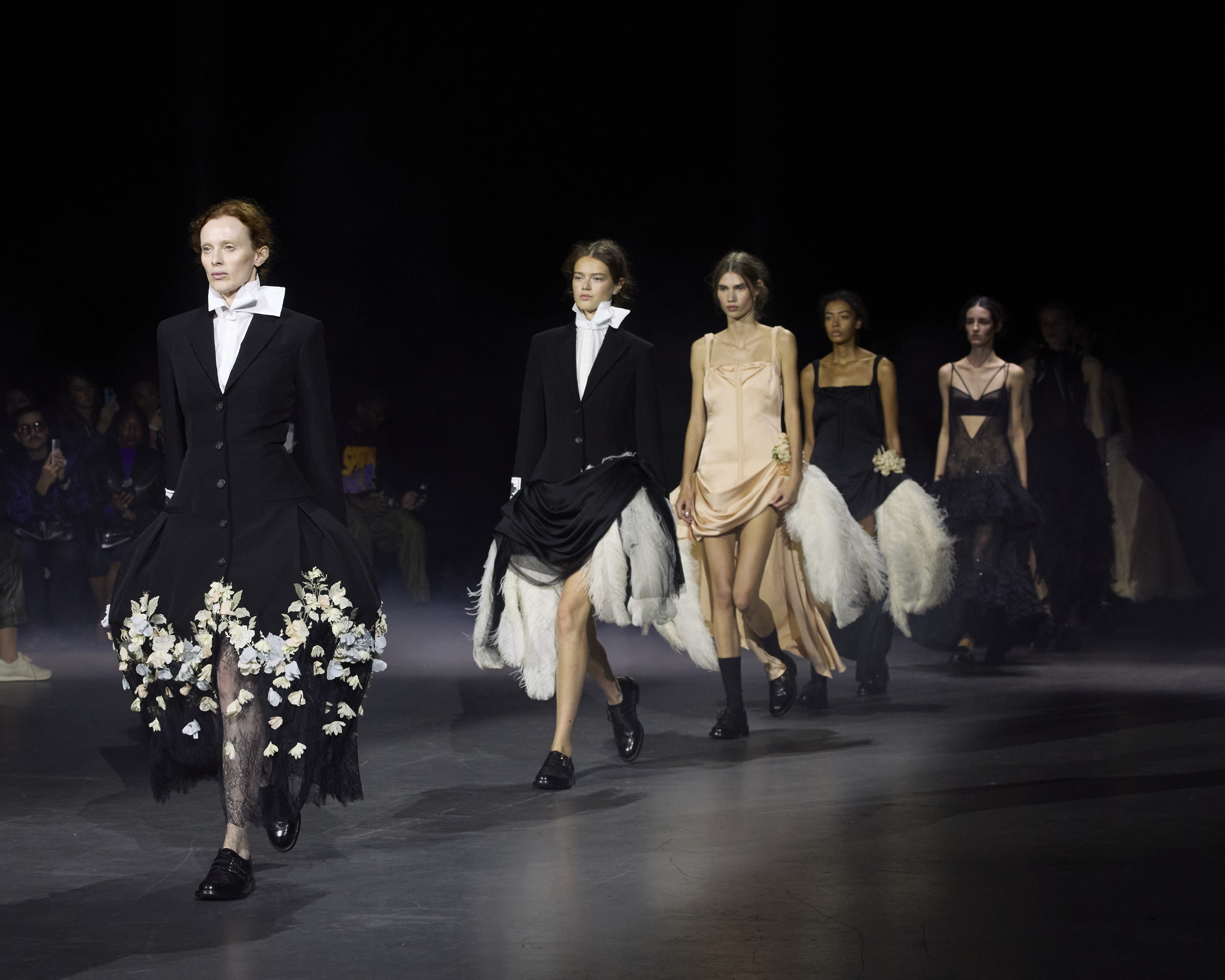
Black grain de poudre brings the authority of traditional eveningwear, but Erdem immediately unsettles it. A cropped tuxedo jacket with a fringed scarf lapel appears with a crisp white poplin shirt and crystal-embellished satin micro shorts. Elsewhere, the tuxedo is spliced open above a crystal bra, while an hourglass jacket meets embroidered tulle gathered into the suggestion of a bustle.
Nothing is quite permitted to remain what convention says it should be.

That is what makes SS27 more interesting than a straightforward conversation about masculine versus feminine. Erdem does not simply place menswear beside womenswear. He alters the grammar of both.
Prince of Wales checks appear alongside boxer shorts; menswear knits hover over skeletal constructions of crystal-strewn tulle. Poplin shirts acquire flyaway collars. Lingerie emerges beneath tailoring not as an interruption, but as an equal part of the silhouette. The opposition gradually dissolves.
Erdem’s romanticism, meanwhile, is grounded in rigorous construction. Skeletal tulle dresses trace the body with crystal; deconstructed lingerie slips in vivid lemon and lime appear almost caught in the process of coming undone. Satin is crushed, corsetry exposed and surfaces interrupted by fragments of embellishment.

Flowers remain — inevitably, beautifully — but even they resist uncomplicated prettiness. Petals and crystals move through pink, lilac, periwinkle, vermilion and ice blue, often appearing against black tailoring or exposed lingerie. Romance is present, but something always disturbs its perfection.
Then comes another collision: Barbour.

Forest-green waxed cotton introduces the pragmatic vocabulary of British utility clothing into Erdem’s world of satin, crystal and lace. Exaggerated outerwear appears against tiny embellished shorts and delicate knits. The contrast sharpens both sides: satin seems more sensual beside utilitarian cloth, while the practical coat becomes unexpectedly theatrical in its new surroundings.
As the collection progresses, proportion begins to expand. Panniers push away from the body. Ostrich feathers erupt from silhouettes. Opera coats in crushed ice-blue and petal-pink satin swell around the figure, their extravagant volumes opening onto the smallest bras and micro shorts beneath.

Concealment becomes exposure; structure gives way to movement, only to find structure again.
Here, the connection to Barbette feels particularly resonant. An aerialist’s apparent weightlessness depends upon immense physical control. Illusion depends upon technique. Glamour depends upon construction.
The same contradiction runs through Erdem SS27. Those skeletal dresses may appear barely there, yet their fragility is engineered. The opera coats look extravagant and effortless, yet their volume is meticulously controlled. Even the fractured surfaces are carefully composed.
Beauty may appear unstable; the workmanship beneath it is anything but.
By the final stretch, black returns. Hand-moulded skeletal tulle, satin, feathers and hourglass tailoring bring a darker intensity. The tuxedo reappears too — spliced and transformed, no longer carrying quite the certainty with which it began.

Perhaps that is the quiet intelligence of Erdem SS27.
Fashion has always possessed the ability to transform a body. Moralioglu is interested in something subtler: its ability to unsettle the assumptions attached to what we see. Masculine and feminine are neither asked to compete nor forced into resolution. Instead, Erdem finds possibility in the territory between them.
Barbette once suspended an audience between what it thought it understood and what it was actually seeing.
A century later, Erdem leaves beauty suspended there too.
Not unresolved. Free.
Editorial by Gulfiya Yebergenova
ARRVL — A Contemporary Fashion Diary
