In Paris, the winner of the Unique Fashion Foundation’s 2026 sustainability competition presented a quieter proposition for contemporary luxury — one rooted in botanical inspiration, Italian craftsmanship and a commitment to making differently.
Editorial and Photography by Gulfiya Yebergenova for ARRVL
Fashion has become fluent in the language of sustainability. The more compelling question is what happens when sustainability moves beyond the message and begins to shape the garment itself.
At Unique Fashion Show Paris 2026, held on 30 May at the historic Réfectoire des Cordeliers in Saint-Germain, one answer arrived through Ciriana Haute Coat.
The emerging Italian label came to Paris as the first-prize winner of the Circle X Sustainability Contest, an initiative of the Unique Fashion Foundation developed with an international jury that included Inside Fashion Design and Sustainable Fashion Week US.
Its winning collection, A Botanical Reverie / Morphira, was recognised for its artistic direction, visual language and considered approach to materiality and craftsmanship.
But Ciriana’s story reaches beyond a single Paris runway.

A House Reconsidered
Ciriana Haute Coat, in its current form, emerged in 2023 with outerwear at the centre of its identity and a deliberate focus on longevity.
Rather than treating sustainability as an addition to the finished product, the label has attempted to build it into the foundations of the garment.
Organic cotton, silk and natural materials form its vocabulary. Ciriana says its current line is biodegradable, plastic-free and fully Made in Italy, with traceability extending across its materials. Synthetic dyes are largely avoided in favour of undyed textiles and a softer natural palette, while botanical printing and plant-derived colour introduce pattern and detail.
The coat, in this world, becomes more than seasonal outerwear.
It becomes an exercise in permanence.


The Luxury of Restraint
Ciriana describes its aesthetic through the language of quiet luxury, yet its interpretation is less about the familiar codes of discretion than about endurance.
The idea is straightforward: fewer pieces, considered more carefully and designed to remain in the wardrobe beyond the rhythm of a single season.
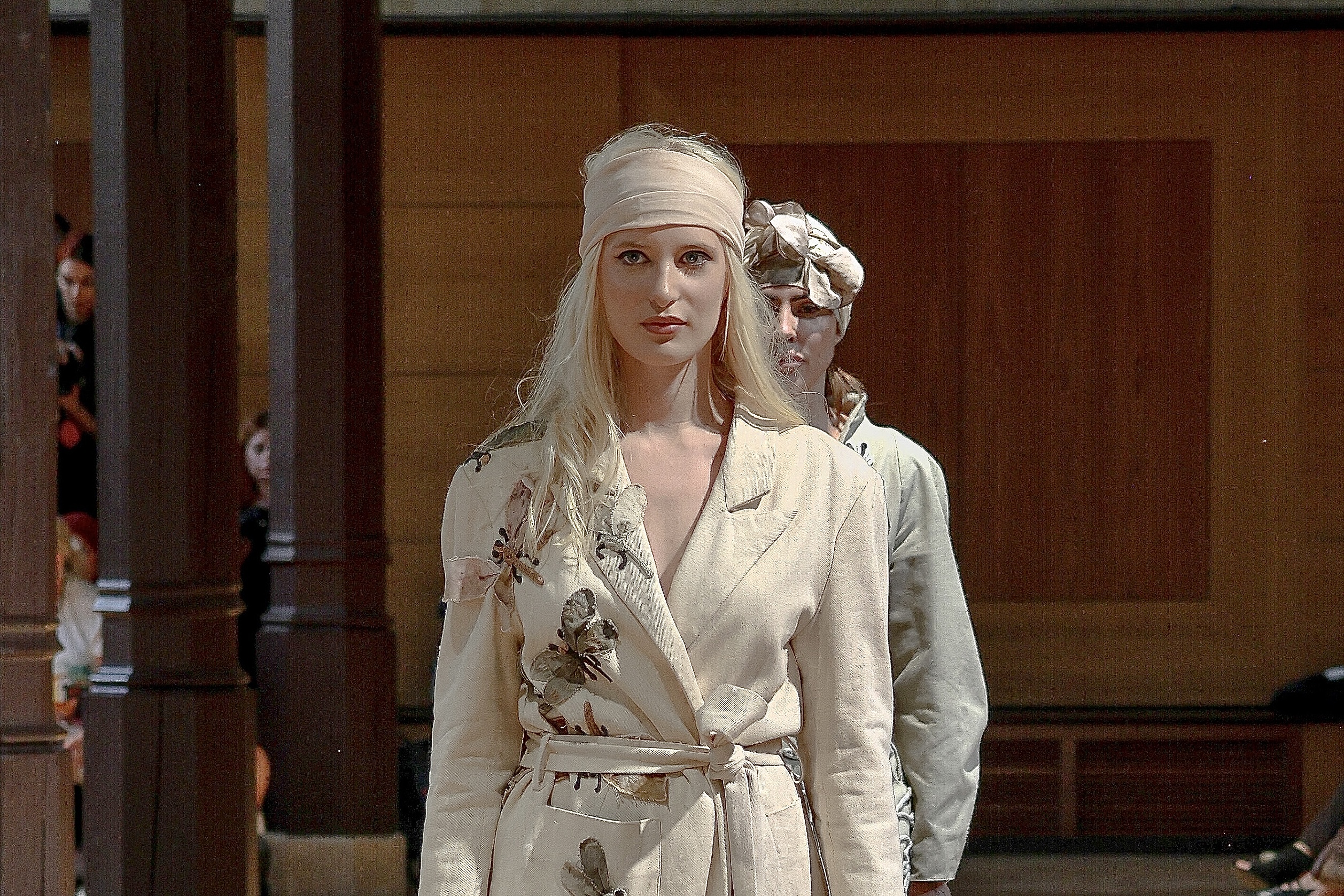
That philosophy appears through elongated fit-and-flare silhouettes, standing collars, sculpted sleeves, wooden fastenings, hand-worked embroidery and botanical motifs.
Nature is present throughout, but not simply as decoration.
On the Willow Coat, branches are articulated through embroidery made from organic cotton tape. Elsewhere, leaves appear through plant-based colour and hand-painted botanical details. Pieces including the Selene, Lamelia, Magnolia, Faun and Dahlia extend the vocabulary through variations of volume, tailoring and romantic structure.
There is femininity here, but also tactility: garments that reveal themselves through construction and detail rather than immediate spectacle.
And this is where Ciriana’s proposition becomes more interesting.
Sustainability is not positioned outside the design language. It participates in it.


From Botanical Chic to Morphira
Ciriana’s exploration of nature had already become visible through Botanical Chic, a project centred on undyed organic cotton, hand-worked embroidery and colour derived from plant-based processes.
The botanical reference subsequently evolved into A Botanical Reverie / Morphira, the collection recognised by the Circle X Sustainability Contest in 2026.
For the international jury, the strength of the project extended beyond its ecological credentials. The collection was recognised for the relationship between artistic direction, materiality, craftsmanship and botanical inspiration.
That distinction matters.
Sustainable fashion has often existed as a category adjacent to fashion itself — evaluated first according to what it avoids and only afterwards according to what it creates.
Ciriana proposes a more interesting possibility: that environmental responsibility can become part of the creative vocabulary rather than a limitation upon it.
Paris, May 2026
The Paris setting placed that conversation within a wider international context.
Inside the Réfectoire des Cordeliers, Unique Fashion Show brought together designers and creative voices from different countries through a programme connecting fashion, art, digital innovation and sustainability.
Created by the Unique Fashion Foundation, the platform places particular emphasis on emerging talent, international exchange and the evolving relationship between fashion, technology and responsible design.
Within that framework, the Circle X Sustainability Contest brought independent designers into a conversation around what a more considered fashion system might look like.
Ciriana, representing Italy, received first prize for A Botanical Reverie / Morphira. The United Kingdom’s Pambo Letu received second prize as well as Best Accessories Brand, while EKCHARKHA of India was awarded third prize.
For Ciriana, Paris represented more than another presentation.
It placed a young label — and its particular interpretation of conscious luxury — before an international audience.
A Different Measure of Progress
There is an intriguing tension at the centre of Ciriana Haute Coat.
Fashion businesses traditionally operate through expansion: more collections, more seasons, more product and an increasingly rapid cycle of newness.
Ciriana’s proposition moves in another direction.
Fewer compromises in material. Greater attention to longevity. A garment conceived not simply around the moment in which it appears, but around the length of time it might remain relevant.
Aesthetically, however, restraint does not mean austerity.
Embroidery moves across surfaces. Sleeves gather and flare. Botanical forms interrupt otherwise controlled silhouettes. Romanticism exists alongside structure.
The result suggests that responsible fashion does not have to relinquish imagination in order to become serious about its impact.
Ciriana Haute Coat remains an emerging independent label, and its next chapters will determine how successfully this philosophy develops within the wider luxury landscape.
But emerging fashion can be particularly compelling at precisely this stage — when an identity is still being formed and its codes are not yet fixed.
On the Paris runway, Morphira offered a glimpse of those codes: Italian craftsmanship considered through an ecological lens, nature treated as both inspiration and material collaborator, and outerwear approached with the intention of longevity rather than disposability.

For Ciriana Haute Coat, Paris marked another chapter in a young story — one shaped by Italian craftsmanship, botanical imagination and an increasingly conscious vision of luxury.
ARRVL — A Contemporary Fashion Diary
