For Haute Couture Fall–Winter 2026–2027, Alexis Mabille staged DUAL as a runway of two perspectives — where the first look was only half the story.
Paris, 7 July 2026
For a few moments, Alexis Mabille appeared to have given everything away.
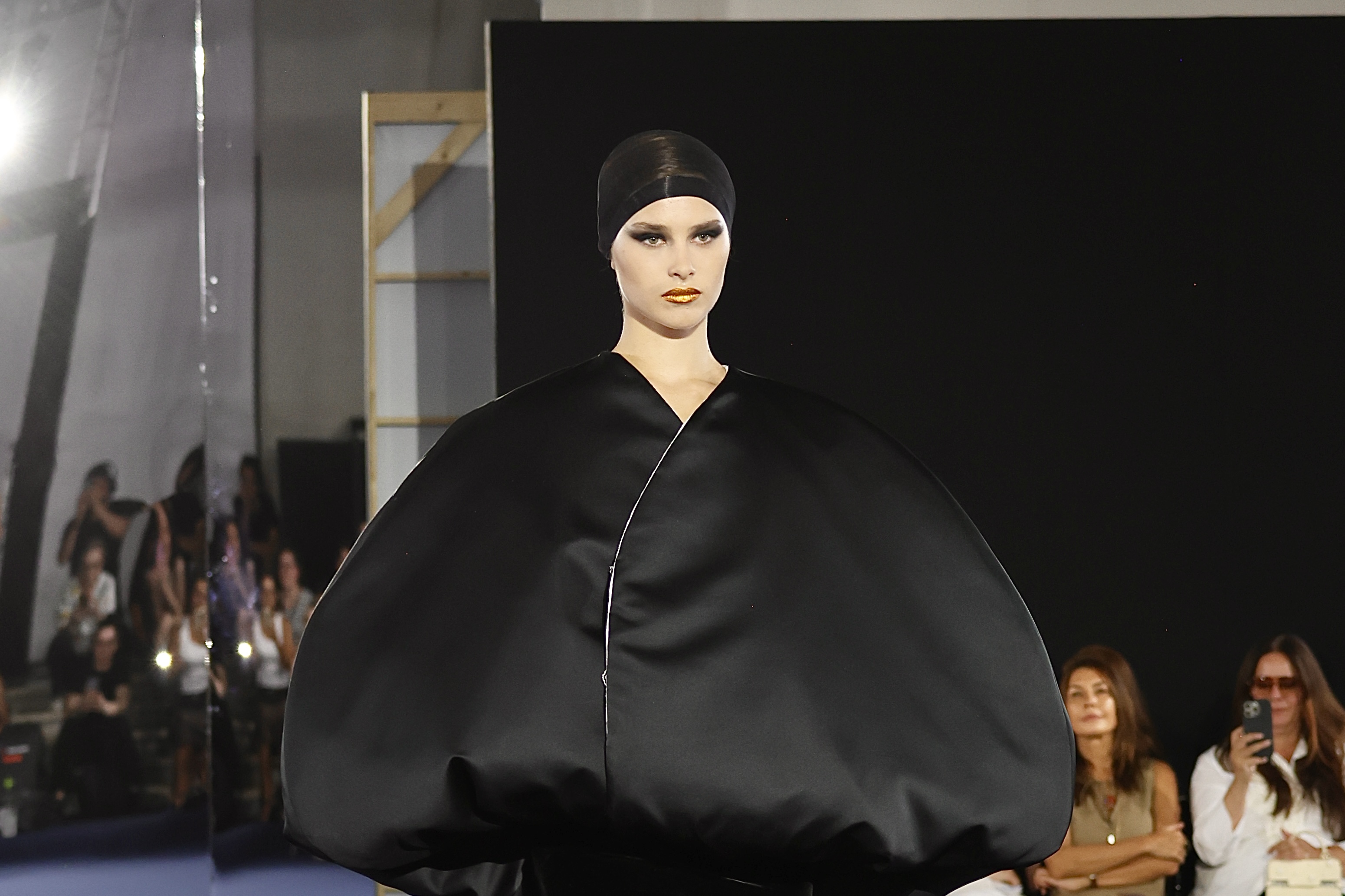
The models arrived together, filling the runway at once. Predominantly dressed in black, they formed a striking collective portrait: long, controlled silhouettes, sculpted volumes and evening shapes held in an almost deliberate restraint.

It was an arresting beginning. It was also only the beginning.
When the models returned individually, the collection changed before our eyes.
What had initially registered as black began to open into colour. A turn of fabric revealed another surface; a reversal changed the character of a silhouette. Rose-gold appeared from darkness. Safflower pink, Nile blue, midnight blue, silver and gold interrupted the severity of the opening. Lace emerged where moments earlier there had been structure.
The first impression had been carefully constructed so that the second could undo it.

DUAL
Mabille called the collection DUAL, and its premise was embedded in the clothes themselves.
Rather than presenting transformation as a styling trick, he constructed it into the garments. Dresses, coats and capes were conceived with another possibility hidden within them — reversible, opening, turning or shifting to expose a second expression of the same piece.
A black T-shaped sheath could reverse into gold lamé. A black tuxedo cardigan disclosed rose-gold. A black cape-dress became safflower pink veiled in Lyon lace. Midnight-blue satin transformed into silver lamé, while elsewhere pink taffeta and ivory Chantilly lace appeared from beneath a dark exterior.
Yet listing those transformations only tells part of the story.
On the runway, their impact came from timing.
The audience had already seen these silhouettes once. We thought we knew them. Their return forced the eye to reconsider what it had registered only minutes before.
Couture in Motion
That made movement unusually important.
Haute Couture naturally invites close observation: embroidery, construction, fabric and finishing are often best appreciated in detail. Here, however, Mabille made the act of changing the garment part of its beauty.
Double-face satin, silk velvet, brocade, lamé, crystal knit, sequins and Chantilly and Lyon lace moved between concealment and exposure. Some pieces deliberately revealed Haute Couture finishing normally associated with the interior of a garment.
The inside was no longer simply an inside.
That reversal gave DUAL its most interesting tension. The clothes could be austere and sensual, minimal and extravagant, dark and luminous without asking one identity to defeat the other.
Both could exist.
When Black Became Colour
The show’s progression from darkness into colour was particularly effective from the audience.
Black established the collection’s first visual language. It gave the opening an almost graphic clarity and allowed silhouette to command attention before embellishment and colour entered the conversation.
Then came the interruptions.
A flash of rose-gold. Blue sequins embroidered with gold. Saffron satin. Pink. Silver. White Chantilly lace.


Colour felt discovered rather than simply presented.
It is an important distinction. The colourful versions were not a conventional second chapter following a black opening; in many cases, they had been there all along, physically contained within the garments we had already seen.
The Second Look
Perhaps that is why DUAL worked particularly well as a live runway experience.
Fashion photography inevitably freezes a fraction of a second. Mabille’s proposition existed somewhere between those fractions: before and after a turn, between one side of a garment and another, between what the audience believed it had seen and what was subsequently revealed.
For ARRVL, photographing the show became an exercise in capturing both identities.
One frame could record the restraint of the first appearance; another, taken moments later, could contain colour, movement and an entirely different attitude. Neither photograph tells the complete story on its own.
The room reflected the international character of couture week too, with Tina Leung, Jordan Roth and actress Zhang Xinyu among the guests watching the transformations unfold from the front row.
But ultimately, the attention belonged to the clothes — and to Mabille’s decision to make us look at them twice.
In an industry built around the arrival of the next image, DUAL proposed something more intriguing: perhaps the image we have already seen still has something left to reveal.
By Gulfiya Yebergenova
Founder & Editor-in-Chief, ARRVL
Photography: Gulfiya Yebergenova / ARRVL
